

If you’re a small business owner shopping for a Help Scout alternative, there’s a good chance you already ran the numbers on Help Scout and didn’t love what you found. The per-contact pricing model sounds reasonable until you actually model it against your customer volume — and then it starts looking like a cost that grows faster than your business should tolerate.
This guide breaks down what Help Scout’s pricing actually means at scale, where the product falls short for small teams, and why flat-rate pricing is the right model for businesses that are actively trying to grow.
The Sticker Shock Moment
Help Scout has repositioned its pricing around contacts rather than agents, which sounds like a friendly model on the surface. You’re not being charged per team member — you’re being charged based on how many customers you support.
The problem is that for small businesses, those two things are correlated. When your customer base grows, your support volume grows with it. When your support volume grows, your Help Scout bill grows. You’re paying more precisely because your business is succeeding.
For a SaaS business with 500 active customers, Help Scout’s costs stay manageable. For a business with 2,000 active contacts, the bill jumps. For an e-commerce store running promotions and adding thousands of new customers during peak seasons, the cost can spike unpredictably.
That’s the structural problem with contact-based pricing: it introduces variability at the worst time.
Help Scout’s Pricing Model, Explained Clearly
Help Scout’s paid plans charge based on the number of “contacts” in your account — essentially, the customers you’ve corresponded with. As your contact count grows, you graduate into higher pricing tiers.
A small business at 1,000 contacts per month is paying a certain rate. At 2,000 contacts, they’re paying more. At 5,000 contacts, they’re paying significantly more. The unit economics look fine until growth accelerates, and then the bill follows.
For comparison:
Help Scout at 1,000+ contacts per month: Typically starts around $50-$100/month depending on plan, and rises as contacts scale. Reporting, AI features, and integrations are often gated behind higher tiers.
HelpLoom flat rate: $29/month, regardless of contact volume. Unlimited users, unlimited threads, unlimited team members. The bill does not change because your customer base grew.
The math becomes stark when you think about a business doing a product launch or a marketing push that temporarily doubles inbound volume. Help Scout’s cost spikes. HelpLoom’s cost stays flat.
Real Math: 1,000 Contacts vs. Flat Rate
Let’s model a specific scenario: an e-commerce brand with a seasonal sales spike.
Normal months: 800 contacts. Help Scout mid-tier plan: around $75/month.
Promotion month: 2,500 contacts. Help Scout higher tier: $150-$200/month.
Annual cost with a typical contact-based model: Averaging out the spikes, expect $1,000-$1,500/year.
HelpLoom: $29/month, every month. Annual cost: $348.
That’s a difference of $650 to $1,150 per year — not because HelpLoom offers less, but because the pricing model is fundamentally different. You’re paying for access to the tool, not for the volume of customers you serve.
For businesses at $29/month with HelpLoom’s $59/month AI plan, even the AI tier costs less per year ($708) than most mid-volume Help Scout plans.
Where Help Scout Falls Short
Help Scout has a strong reputation for clean design and a focus on the human side of support. That reputation is largely deserved. But several areas create friction for small businesses evaluating it honestly.
Knowledge Base Limitations
Help Scout’s Docs product is a separate layer. The integration between your support inbox and your documentation isn’t as tight as you’d want. Building a comprehensive help center requires navigating between two product surfaces, and the search functionality has drawn consistent criticism from users for returning poor results.
For small teams, a disconnected knowledge base means documentation gets neglected. It’s easier to answer the same question for the hundredth time than to wrangle a separate documentation system.
AI Feels Bolted On
Help Scout added AI features, but they feel like a layer added to an existing product rather than a system designed with AI from the start. The AI summarization and drafting tools are useful. The AI chatbot for customer-facing deflection is limited compared to tools that were built AI-first.
For a small business trying to reduce ticket volume without hiring, the AI chatbot is often more valuable than the AI writing tools. Help Scout’s current offering skews toward the latter.
Automation Reliability
Help Scout’s automation rules have a documented history of inconsistency. Forum threads from multiple years show recurring issues with rules not firing reliably, conditions behaving unexpectedly, and updates that reset configuration. For a small team that sets up automations and expects them to run quietly in the background, this kind of unreliability is a real maintenance cost.
What to Look for in a Help Scout Alternative
When you’re evaluating alternatives, the criteria that matter for small businesses are:
Pricing that doesn’t penalize growth. Any tool that scales price with contact volume or agent count will cost you more precisely when you’re succeeding. Look for flat-rate tools that don’t care how many customers you have.
AI built in from the start, not added later. AI-first support tools have a fundamentally different architecture. The chatbot knows your knowledge base. It escalates appropriately. It improves as your documentation improves. Tools that added AI to an existing product don’t behave the same way.
A knowledge base that connects to your inbox. Documentation and support should be one system. When a support rep writes a great answer, publishing it as a help article should be one click away.
Fast setup that doesn’t require an engineer. If you need to file a ticket with your dev team to go live, you’ve already lost a day and created resentment. The best tools work with a copied script.
Why HelpLoom Is the Right Move Here
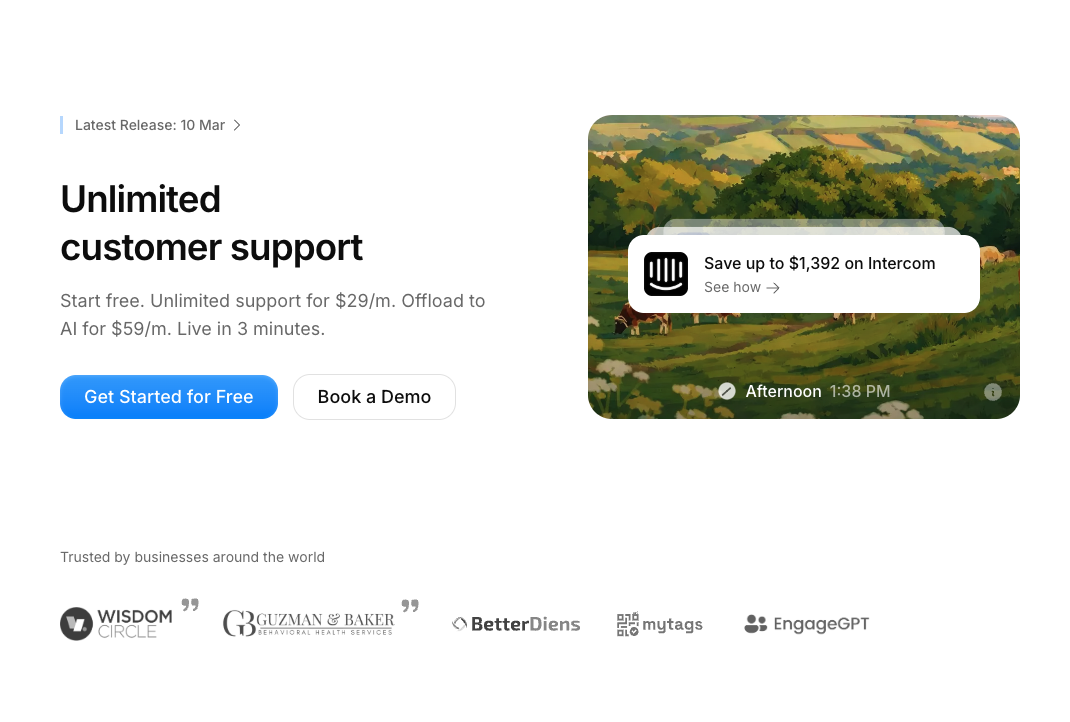
HelpLoom was built with flat-rate pricing as a foundational choice, not a marketing position. The reasoning is simple: small businesses shouldn’t face a surprise invoice because they had a good month.
At $29/month, you get unlimited users, unlimited team members, unlimited threads. Your whole support team, no matter how it grows, is covered. At $59/month, the AI chatbot trains on your knowledge base and handles the common questions before they reach your inbox — with intelligent escalation when something needs a human.
The help center is built in, not bolted on. It includes a sitemap.xml, so your documentation gets indexed by search engines. Your knowledge base becomes a customer acquisition tool, not just a support tool.
Setup takes under three minutes. There’s a copy-paste script that works with React, HTML, Webflow, WordPress, Shopify, Framer, and Bubble. No engineering required, no implementation call, no professional services engagement.
That’s the difference between a product designed for small businesses and one that was designed for someone else and priced for you after the fact.
Other Alternatives Worth a Look
Freshdesk has a generous free tier and predictable paid plans. It’s a solid choice for teams that want a lot of feature depth at relatively low cost. The per-agent pricing on paid plans is less punishing than Zendesk, though it still exists. The AI features are present but feel underdeveloped compared to AI-first tools.
Zoho Desk is notably affordable and integrates tightly with the Zoho ecosystem. If you’re already using Zoho CRM, it’s worth considering. The interface has historically been less polished than Help Scout or HelpLoom, though recent updates have improved it. Again, per-agent pricing applies on the plans where you need meaningful features.
Both are reasonable products. Neither offers the flat-rate model that removes the growth penalty entirely.
The Honest Summary
Help Scout is a quality product for the right customer. That customer is probably a stable team with predictable contact volume that values design and a human-centered support philosophy.
If you’re a small business that’s growing — adding customers, running promotions, expanding into new markets — Help Scout’s pricing structure works against you. The bill grows with your success. That’s a bad deal.
The better model is paying for access to the tool, not for the volume of customers you’re serving. HelpLoom is built on that model, at a price that makes the math obvious.