
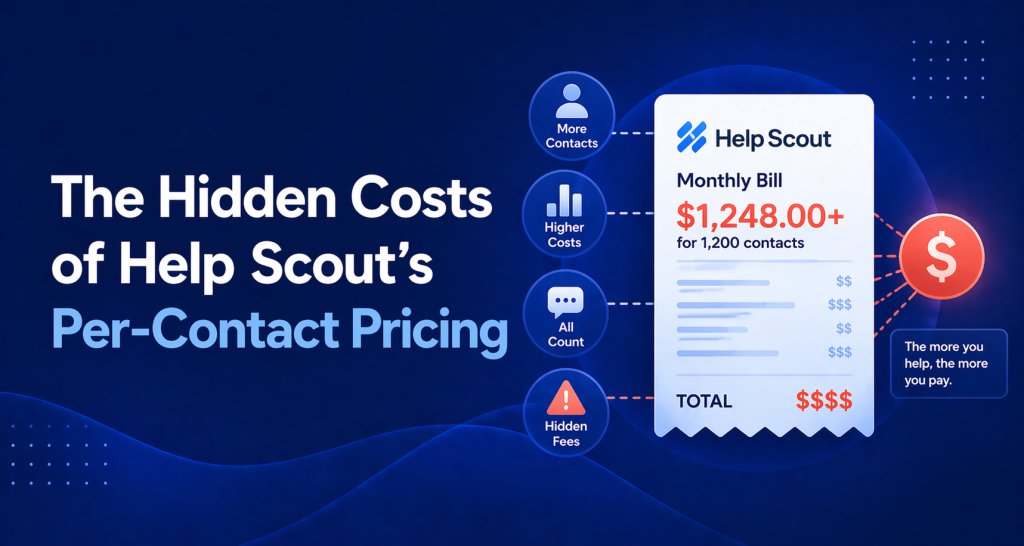
Help Scout looks reasonably priced until you understand how their billing model actually works.
The headline number — starting around $20-$22 per user per month on the entry plan — sounds manageable. Especially compared to Zendesk or Intercom. Many small teams sign up based on that number and don’t think hard about the per-contact structure underneath it.
Then the bill arrives.
This article explains Help Scout’s pricing model clearly and honestly, walks through what it actually costs at different scales, and shows how it compares to flat-rate alternatives. If you’re currently evaluating Help Scout pricing or wondering why your bill keeps changing month to month, this is for you.
How Help Scout’s Per-Contact Pricing Model Works
Help Scout’s billing has two layers that interact in ways that aren’t always obvious upfront.
The first layer is per-seat pricing. Each user on your team who needs access to the inbox costs a monthly per-user fee. For a team of 5, that’s 5x the per-seat rate.
The second layer is contact-based limits. Help Scout’s plans include a cap on the number of unique contacts in your account. A “contact” is a customer record — any customer who has ever sent your team a message or been added to your system.
As your contact list grows — which it will, because you’re running a business — you eventually hit the contact limit on your current plan and need to upgrade to the next tier. That upgrade costs more. And because contacts are cumulative (not monthly), the clock doesn’t reset.
The combination of per-seat pricing and contact limits creates a billing model that moves in two directions simultaneously as you grow.
The Math at Different Scales
Let’s walk through concrete numbers. These are based on Help Scout’s published pricing tiers as of early 2026. (Always verify current pricing at helpscout.com before making decisions.)
At 500 Contacts
A small team of 3 support staff on the entry plan:
- 3 seats x ~$22/month: ~$66/month
- Contact limit: typically 1,000 contacts on lower tiers, so you’re within range
Monthly cost: ~$66
This is the scenario where Help Scout looks affordable. Small team, low contact volume, straightforward.
At 1,000 Contacts
Same 3-person team, growing customer base:
- Still on the same tier if you’re near the cap, or bumped to the next tier
- Some plans include AI features as add-ons at this level, billed separately
- If you’re adding team members as you grow: 4 seats x ~$22-$35/month (rate increases on higher tiers)
Monthly cost: $88-$140+ depending on plan tier and seat count
The contact limit starts mattering here. If your business grew to 1,000 contacts faster than expected — say, after a promotion — you may hit the wall before you anticipated.
At 2,500 Contacts
Now you’re running a real operation. Maybe 4-5 support staff. Growing customer list. Using Help Scout’s features more deeply.
- 5 seats on a mid-tier plan: roughly $35-$50/seat/month
- You’ve likely upgraded plans due to contact limits
- AI features (Assist, Summarize, etc.) are add-ons on some plans, not included in base price
- Contact limit on higher tiers: typically 25,000, but AI resolutions tracked separately
Monthly cost: $175-$250+, potentially more with AI add-ons
At this scale, Help Scout is a meaningful line item. And here’s the compounding problem: as your contact list grows, you can’t shrink it back down. You can’t “un-contact” someone to get back under a tier limit. The only direction is up.
The Hidden Gotchas
A few things that aren’t immediately obvious when you read Help Scout’s pricing page:
What counts as a “contact.” Any customer who has ever reached out is a contact. This includes people who emailed once two years ago and never again. If you’ve been in business for a few years and have an engaged customer base, your contact count is probably higher than you think, even if your active monthly support volume is modest.
AI features are not always included in the base plan. Help Scout’s AI writing assistance tools (Reply Suggestions, Summarize, etc.) are positioned as add-ons or only available on higher tiers. If part of your reason for evaluating Help Scout is the AI capabilities, make sure you’re pricing the tier that actually includes what you need, not the entry-level rate.
The upgrade path is one-directional. Once you’re on a higher-tier plan due to contact limits, you generally can’t downgrade if your volume normalizes. You’re locked in at the higher rate.
Per-seat pricing doesn’t forgive seasonal teams. If you bring in a temporary support person for the holidays, that’s another seat at the monthly rate. Some tools prorate this; per-seat pricing generally doesn’t reward flexibility.
What Help Scout Does Well
Before going further with the critique, it’s worth being direct about where Help Scout genuinely excels.
Clean, email-centric UI. Help Scout’s interface is one of the cleanest in the industry. It feels like a well-designed email client, which makes onboarding new support staff fast. There’s very little learning curve.
Solid email experience. If your primary support channel is email and you want it to feel polished and professional, Help Scout handles this well. Conversation threading, notes, assignments — all clean and reliable.
Docs (help center) product. Help Scout’s Docs product is well-designed and easy to maintain. If you’re building a help center, it works.
Established product with good integrations. Help Scout has been around for over a decade and has mature integrations with most common tools.
If you have a small, stable team with a predictable contact list and your primary need is a polished email inbox, Help Scout is a reasonable choice. The frustrations show up when you’re growing fast, adding team members, or trying to budget around variable support volume.
The Alternative Model: Flat-Rate Pricing
The fundamental difference with flat-rate pricing is that your support costs are decoupled from your customer list size, your team size, and your ticket volume.
You pay a fixed monthly amount. You can have 3 support staff or 10. You can have 500 contacts or 5,000. Your bill doesn’t change.
This matters for a few reasons:
First, it makes budgeting trivial. You know exactly what you’ll spend on support every month, regardless of whether you launch a promotion, hire a seasonal helper, or acquire 500 new customers.
Second, it removes the perverse incentive to avoid growth. With per-contact pricing, every new customer you acquire is a liability in your contact count. That’s a bizarre economic signal. Your support infrastructure should benefit from your growth, not penalize it.
Third, it allows your team to scale without a proportional cost increase. On per-seat pricing, adding a team member means a permanent increase in your monthly bill. On flat-rate pricing, you can add as many team members as you need.
HelpLoom’s Pricing vs. Help Scout
HelpLoom is flat-rate with no per-agent fees and no contact limits.
- $29/month: Unlimited users, unlimited threads, unlimited contacts. Full shared inbox. Built-in help center with sitemap.xml.
- $59/month: Everything above, plus AI chatbot trained on your knowledge base, with automatic escalation to human agents.
Compare that to Help Scout at 1,000 contacts with a 4-person team: roughly $88-$140/month depending on plan tier, before AI features.
At 2,500 contacts with 5 team members: $175-$250+/month on Help Scout. $29/month on HelpLoom.
The gap isn’t marginal. For a growing small business, that’s thousands of dollars per year in support infrastructure costs.
The HelpLoom setup is also fast: copy-paste script, no engineering, live in under 3 minutes. Joanna Sundharam, Head of Product at WisdomCircle, went live in 20 minutes. The simplicity isn’t a limitation — it’s the point.
When Per-Contact Pricing Makes Sense (And When It Doesn’t)
To be fair: per-contact pricing can make sense for a very early-stage business with a tiny customer list and no plans to grow quickly. At 200 contacts and 2 team members, Help Scout’s entry tier is genuinely affordable.
The problem is that most businesses that start there don’t stay there. Growth is the goal. And every new customer you acquire accelerates the cost curve.
If you’re planning to grow your customer base — which is presumably why you’re in business — flat-rate pricing will almost always be cheaper over a 12-24 month horizon.
The question to ask isn’t “what does this cost me today?” It’s “what does this cost me at twice my current customer base, with one more person on the support team?” Run that math before you commit.
See What Your Support Should Actually Cost
If you’re currently on Help Scout and watching your bill climb as your contact list grows, or if you’re evaluating it and the pricing model feels complicated, there’s a simpler option.
HelpLoom is $29/month regardless of how many contacts you have, how many team members need access, or how much your support volume grows. The $59/month plan adds AI that trains on your knowledge base and escalates automatically when it can’t answer.
No per-contact limits. No per-seat fees. No surprises.